Tetra-n-butylammonium fluoride trihydrate About
LC5703 Tetra-n-butylammonium fluoride trihydrate
for synthesis
Order number Packaging Quantity Price
AC32703 Glass bottle 10 g
18.675
AC32703 Glass bottle 50 g 72.90
Product information
Synonyms TBAF
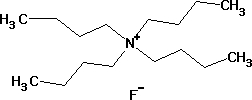
Hill Formula C16H36FN * 3H2O
Chemical formula (CH3CH2CH2CH2)4NF
HS Code 2923 90 00
EC number 207-057-2
Molar mass 315.52 g/mol
CAS number 87749-50-6
Chemical and physical data
Solubility (20 C) soluble
Melting point 62 - 63 C
Molar mass 315.52 g/mol
Safety information according to GHS
Hazard Statement(s) H301: Toxic if swallowed.
EUH032: Contact with acids liberates very toxic gas.
Precautionary Statement(s) P260: Do not breathe dust.
P262: Do not get in eyes, on skin, or on clothing.
Signal Word Danger
Hazard Pictogram(s)
Storage class 6.1A Combustible substances, toxic
WGK WGK 3 highly water endangering
Disposal 23
Hydrogen fluoride and inorganic fluorides as well as solutions thereof must be handled with extreme caution. Do not permit contact of any kind under any circumstances and be sure to work under an efficient fume cupboard with the front screen closed. Residues dissolved in water can be precipitated as calcium fluoride. Solids or precipitate: container I; filtrate: container D or E.
Safety information
R Phrase R 25-32
Toxic if swallowed.Contact with acids liberates very toxic gas.
S Phrase S 24/25-45
Avoid contact with skin and eyes.In case of accident or if you feel unwell, seek medical advice immediately (show the label where possible).
Categories of danger toxic
Hazard Symbol Toxic
Transport information
Declaration (transport by sea) IMDG-Code UN 2811 TOXIC SOLID, ORGANIC, N.O.S.(TETRA-N-BUTYLAMMONIUM FLUORIDE TRIHYDRATE), 6.1, II
Declaration (transport by air) IATA-DGR UN 2811 TOXIC SOLID, ORGANIC, N.O.S.(TETRA-N-BUTYLAMMONIUM FLUORIDE TRIHYDRATE), 6.1, II
Specifications
Assay (ex N) 97 %
Versatile Fluoride Source for Research and IndustryTetra-n-butylammonium fluoride trihydrate excels as a preferred reagent in organic chemistry, enabling deprotection and selective fluoride transfer reactions. With a high purity of 97% and laboratory-grade quality, this compound ensures dependable results in both research and industrial applications. Its solubility in water and various polar solvents enables flexible use in diverse synthetic processes.
Handling and Storage RecommendationsGiven its moisture sensitivity, TBAF trihydrate should always be stored at room temperature in a tightly closed container to protect it from humidity. This ensures maximum shelf life, maintaining its crystalline integrity and effectiveness for up to two years under recommended storage conditions.
FAQ's of Tetra-n-butylammonium fluoride trihydrate:
Q: How should Tetra-n-butylammonium fluoride trihydrate be stored to maintain its stability?
A: TBAF trihydrate must be kept in a tightly closed container at room temperature, away from moisture, as it is highly hygroscopic. Following these guidelines helps it remain stable and effective for up to two years.
Q: What applications benefit from using Tetra-n-butylammonium fluoride trihydrate?
A: It is primarily used in organic synthesis for fluoride ion delivery, aiding in deprotection reactions and analytical chemistry processes. Its purity and solubility make it an essential reagent for laboratory synthesis and research.
Q: When is it necessary to take special precautions during handling?
A: Special precautions are required whenever handling TBAF trihydrate due to its potential to cause skin and eye irritation. Personal protective equipment such as gloves and safety goggles should always be worn.
Q: Where is TBAF trihydrate typically supplied and who are the main users?
A: This compound is distributed by dealers, exporters, manufacturers, retailers, suppliers, and traders across India, mainly catering to laboratories, research institutions, and chemical synthesis industries.
Q: What is the process for using TBAF trihydrate in chemical synthesis?
A: Typically, the compound is dissolved in water or a compatible polar organic solvent before being incorporated into synthetic reactions as a fluoride source or catalyst, depending on the specific organic transformation required.
Q: What are the benefits of selecting laboratory grade TBAF trihydrate?
A: Choosing laboratory grade ensures high purity (97%), precise results in sensitive applications, and reliability for a wide range of chemical processes, enhancing experimental reproducibility.


 English
 Spanish
 French
 German
 Italian
 Chinese (Simplified)
 Japanese
 Korean
 Arabic
 Portuguese










 Send Inquiry

 Send Inquiry


