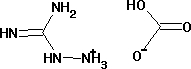
1-Aminoguanidinium hydrogen carbonate About
LC398 1-Aminoguanidinium hydrogen carbonate
for synthesis
Order number Packaging Quantity Price
AC27398 Plastic bottle 250 g 16.47
Product information
Synonyms Aminoguanidine bicarbonate
Hill Formula C2H8N4O3
Chemical formula CH6N4 * H2CO3
HS Code 2928 00 90
EC number 219-956-7
Molar mass 136.11 g/mol
CAS number 2582-30-1
Chemical and physical data
Ignition temperature 245 C
Solubility < - 5 g/l (20 C)
Melting point 125 C decomposes
Molar mass 136.11 g/mol
Density 1.56 g/cm3 (20 C)
Bulk density 700 kg/m3
pH value 8.9 (5 g/l, H2O, 20 C)
Safety information according to GHS
Hazard Statement(s)
H317: May cause an allergic skin reaction.
H411: Toxic to aquatic life with long lasting effects.
Precautionary Statement(s)
P273: Avoid release to the environment.
P280: Wear protective gloves.
P302 + P352: IF ON SKIN: Wash with plenty of soap and water.
Signal Word
Warning
Hazard Pictogram(s)
RTECS
FG1772000
Storage class
10 - 13 Other liquids and solids
WGK
WGK 2 water endangering
Disposal
3
Relatively unreactive organic reagents should be collected in container A. If halogenated, they should be collected in container B. For solid residues use container C.
Safety information
R Phrase
R 43-51/53
May cause sensitization by skin contact.Toxic to aquatic organisms, may cause long-term adverse effects in the aquatic environment.
S Phrase
S 24-37-61
Avoid contact with skin.Wear suitable gloves.Avoid release to the environment. Refer to special instructions/ Safety data sheets.
Categories of danger
sensitizing, dangerous for the environment
Hazard Symbol
Irritant
Dangerous for the environment
Transport information
Declaration (transport by sea) IMDG-Code UN 3077 ENVIRONMENTALLY HAZARDOUS SUBSTANCE, SOLID, N.O.S.(1-AMINOGUANIDINIUM HYDROGEN CARBONATE), 9, III, Marine Pollutant: P
Declaration (transport by air) IATA-DGR UN 3077 ENVIRONMENTALLY HAZARDOUS SUBSTANCE, SOLID, N.O.S.(1-AMINOGUANIDINIUM HYDROGEN CARBONATE), 9, III
Toxicological data
LD 50 oral LD50 rat > 5000 mg/kg
Specifications
Assay (HClO4) 98 %
Identity (IR) passes test
Key Features and Chemical Properties1-Aminoguanidinium hydrogen carbonate, also known as aminoguanidine bicarbonate, presents as a white crystalline solid. It features a pH of 6.5-7.5 in a 1% aqueous solution and dissolves readily in water. The compound is stable under recommended storage conditions and should be kept tightly sealed in a cool, dry environment to preserve its 2-year shelf life.
Applications Across LaboratoriesThis reagent grade chemical is designed for laboratory settings, notably in biochemical research and chemical synthesis. It acts as an intermediate in various synthesis pathways and suits academic and industrial research applications due to its high purity and reliability.
Safe Handling and StorageWhile 1-aminoguanidinium hydrogen carbonate is not classified with a UN number, it is recognized as an irritant. Always handle this compound with appropriate protective equipment, such as gloves, safety goggles, and lab coats. Maintain strict adherence to storage guidelines for maximum safety and product longevity.
FAQ's of 1-Aminoguanidinium hydrogen carbonate:
Q: How should I safely handle and store 1-aminoguanidinium hydrogen carbonate?
A: Handle the compound using suitable protective gear, including gloves, goggles, and a lab coat, as it is classified as an irritant. Always keep it in a tightly closed bottle or sealed drum, stored in a cool, dry place away from incompatible materials.
Q: What are the primary uses of 1-aminoguanidinium hydrogen carbonate in the laboratory?
A: This reagent is primarily used in biochemical research, chemical synthesis, and as an intermediate for preparing other compounds. Its high purity makes it ideal for university lab applications and advanced research experiments.
Q: When does 1-aminoguanidinium hydrogen carbonate decompose, and how is it affected by temperature?
A: The compound decomposes at temperatures above 160C. It does not have a boiling point because it breaks down before reaching that phase transition, so avoid exposing it to high heat during storage or use.
Q: Where can I procure 1-aminoguanidinium hydrogen carbonate in India?
A: You can obtain this chemical from authorized dealers, exporters, manufacturers, retailers, suppliers, or traders across India. Several suppliers offer custom packaging sizes and cater to university and research requirements.
Q: What is the benefit of using reagent-grade, high-purity 1-aminoguanidinium hydrogen carbonate?
A: The 98% purity ensures consistent results and reliability in laboratory research and synthesis, reducing the risk of unwanted by-products or variability in experiments.
Q: Can I dissolve 1-aminoguanidinium hydrogen carbonate directly in water for experimental use?
A: Yes, the compound is readily soluble in water, making it convenient to prepare aqueous solutions suitable for laboratory protocols and research applications.


 English
 Spanish
 French
 German
 Italian
 Chinese (Simplified)
 Japanese
 Korean
 Arabic
 Portuguese











 Send Inquiry

 Send Inquiry


