


 English
 Spanish
 French
 German
 Italian
 Chinese (Simplified)
 Japanese
 Korean
 Arabic
 Portuguese


CERTIFICATE OF ANALYSIS
| Name Of Item : MERCURIC ACETATE |
| Formula : (CH3COO)2Hg |
| ||
|
|
| [mercury (II) acetate] | Batch No. : M0189 |
| |
| M.W. : 318.68 |
|
| |||
| CAS NO. : 1600-27-7 |
|
| Cat. No. : AL2931 00500 |
| |
| |
| ||||
|
|
|
|
|
| |
|
|
|
|
|
|
|
| Type Of Test |
| Standard |
| Observed |
|
|
|
|
|
|
| |
| Description |
| White crystalline powder |
| White crystalline powder |
|
|
|
|
|
|
|
|
| Assay |
| Min. 98.5% |
| 98.57% |
|
| Chloride (Cl) |
| <0.03% |
| 0.02% |
|
| Sulphate (SO4) |
| <0.005% |
| 0.004% |
|
| Iron (Fe) |
| <0.001% |
| <0.001% |
|
| Mercury (I) (as Hg) |
| <0.5% |
| 0.4% |
|
| Substance not reducible with |
|
|
|
| |
| formic acid |
| <0.1% |
| <0.1% |
|
|
|
|
|
|
|
|
Results : The above product complies with LR grade

Price:
Price 32504 INR / Gram
Minimum Order Quantity : 500 Grams
Physical State : Solid (crystalline powder)
Shelf Life : 5 years (if properly stored)
Application : Laboratory, analytical chemistry, preparation of other mercury compounds
Molecular Weight : 342.62 g/mol
Minimum Order Quantity : 25GM Kilograms
Physical State : Crystalline powder
Shelf Life : 5 years from manufacturing date if stored properly
Application : Laboratory use, chemical analysis, water testing
Molecular Weight : 232.66 g/mol
Price 22255 INR / Gram
Minimum Order Quantity : 500 Grams
Physical State : Powder
Shelf Life : 36 months
Application : Laboratory, Analytical Reagent, Chemical Synthesis, Ointments (pharmaceutical grade)
Molecular Weight : 232.65 g/mol
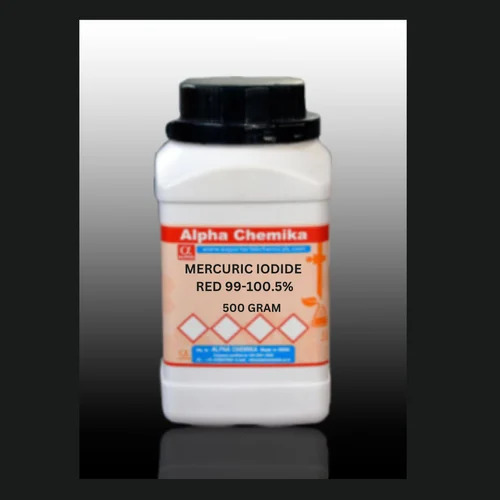
Price 2769 INR / Kilograms
Minimum Order Quantity : 5 Kilograms
Physical State : Powder
Shelf Life : Stable under proper storage
Application : Laboratory
Molecular Weight : 454.4 g/mol



|
 |
ALPHA CHEMIKA
All Rights Reserved.(Terms of Use) Developed and Managed by Infocom Network Private Limited. |

 Send Inquiry

 Send Inquiry


