Potassium Peroxodisulfate About
LC4895 Potassium peroxodisulfate
for analysis (<= 0.001% N) EMSURE,Reag. Ph Eur
Order number Packaging Quantity Price
AC31895 Plastic bottle 250 g 37.80
Product information
Grade ACS,Reag. Ph Eur
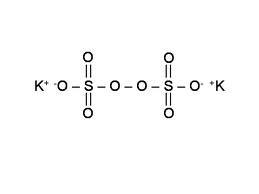
Synonyms Potassium persulfate
Hill Formula K2O8S2
HS Code 2833 40 00
EC number 231-781-8
Molar mass 270.32 g/mol
EC index number 016-061-00-1
CAS number 7727-21-1
Chemical and physical data
Solubility 50 g/l (20 C)
Melting point 100 C (decomposition)
Molar mass 270.32 g/mol
Density 2.48 g/cm3 (20 C)
Bulk density 1150 kg/m3
pH value 4 - 5 (50 g/l, H2O, 20 C)
Safety information according to GHS
Hazard Statement(s) H272: May intensify fire; oxidiser.
H302: Harmful if swallowed.
H319: Causes serious eye irritation.
H335: May cause respiratory irritation.
H315: Causes skin irritation.
H334: May cause allergy or asthma symptoms or breathing difficulties if inhaled.
H317: May cause an allergic skin reaction.
Precautionary Statement(s) P210: Keep away from heat/sparks/open flames/hot surfaces. - No smoking.
P280: Wear protective gloves.
P305 + P351 + P338: IF IN EYES: Rinse cautiously with water for several minutes. Remove contact lenses, if present and easy to do. Continue rinsing.
P302 + P352: IF ON SKIN: Wash with plenty of soap and water.
P304 + P340: IF INHALED: Remove victim to fresh air and keep at rest in a position comfortable for breathing.
Signal Word Danger
Hazard Pictogram(s)
RTECS SE0400000
Storage class 5.1 B Oxidizing agents (TRG 515 Group 2+3)
WGK WGK 1 slightly water endangering
Disposal 22
Inorganic peroxides and oxidants as well as bromine and iodine should be rendered harmless by reduction with acidic sodium thiosulfate solution (Cat. No. 106513); container D or E. Slightly soluble oxidants should be collected separately in container E or I.
Safety information
R Phrase R 8-22-36/37/38-42/43
Contact with combustible material may cause fire.Harmful if swallowed.Irritating to eyes, respiratory system and skin.May cause sensitization by inhalation and skin contact.
S Phrase S 22-24-26-37
Do not breathe dust.Avoid contact with skin.In case of contact with eyes, rinse immediately with plenty of water and seek medical advice.Wear suitable gloves.
Categories of danger oxidizing, harmful, irritant, sensitizing
Hazard Symbol
Oxidising
Harmful
Transport information
Declaration (transport by sea) IMDG-Code UN 1492 POTASSIUM PERSULPHATE, 5.1, III
Declaration (transport by air) IATA-DGR UN 1492 POTASSIUM PERSULPHATE, 5.1, III
Toxicological data
LD 50 oral LD50 rat 802 mg/kg
Specifications
Assay (iodometric) 99.0 %
Insoluble matter 0.005 %
Entire chloride 0.001 %
Total nitrogen (N) 0.001 %
Heavy metals (as Pb) 0.001 %
Fe (Iron) 0.0005 %
Mn (Manganese) 0.0001 %
Safe Handling and Storage GuidelinesStore Potassium Peroxodisulfate in a cool, dry place, away from heat and moisture to maintain its stability and extend its shelf life. Always use airtight, moisture-resistant packaging such as HDPE bags or fiber drums. When handling, wear appropriate protective equipment, and avoid contact with strong acids or reducing agents to prevent hazardous reactions.
Diverse Applications in Industry and ResearchThis compound is valued for its function as a potent oxidizing agent, making it indispensable in laboratory reagent preparation, chemical synthesis, polymerization initiation, and industrial bleaching processes. Its high solubility and purity ensure consistent performance in professional and research environments.
FAQ's of Potassium Peroxodisulfate:
Q: How should Potassium Peroxodisulfate be safely stored and handled?
A: Potassium Peroxodisulfate should be kept in a cool, dry location, protected from heat and moisture, and stored in airtight HDPE bags, fiber drums, or bottles. Always avoid exposure to strong acids or reducing agents to prevent dangerous reactions. Use appropriate personal protective equipment when handling.
Q: What are the main applications of Potassium Peroxodisulfate?
A: This compound is widely used as an oxidizing agent, polymerization initiator, and bleaching agent. It also acts as a laboratory reagent and plays a vital role in chemical synthesis for industrial and research purposes.
Q: When is it necessary to take special precautions with Potassium Peroxodisulfate?
A: Special precautions are essential when the compound is exposed to heat or moisture, as it is sensitive to both. It should also never be mixed with strong acids or reducing agents due to the risk of fire, explosion, or hazardous decomposition.
Q: Where can Potassium Peroxodisulfate be sourced in India?
A: Potassium Peroxodisulfate is available through several channels in India, including dealers, exporters, manufacturers, suppliers, retailers, and traders who offer customized packaging and specifications to suit various user requirements.
Q: What is the recommended process for disposing of Potassium Peroxodisulfate?
A: Disposal should follow local environmental regulations. Small quantities can often be diluted and neutralized, while larger amounts or industrial waste should be managed through licensed hazardous waste disposal facilities to ensure environmental safety.
Q: What are the advantages of using Potassium Peroxodisulfate in laboratory and industrial settings?
A: Its high purity, strong oxidizing capability, stable nature under proper storage conditions, and versatility in multiple applications make it a preferred choice for laboratory and industrial use. It also offers a two to three-year shelf life if stored correctly.


 English
 Spanish
 French
 German
 Italian
 Chinese (Simplified)
 Japanese
 Korean
 Arabic
 Portuguese








 Send Inquiry

 Send Inquiry


