Change Language
P- Toluylacetonitrile

P- Toluylacetonitrile

MOQ : 500 Milliliters

P- Toluylacetonitrile Specification

  • Purity
  • 98%
  • Shelf Life
  • 24 months under recommended storage
  • Size
  • Custom packaging sizes available
  • Physical State
  • Liquid
  • Packaging Type
  • Bottle / Drum
  • Density
  • 1.01 Gram per cubic centimeter(g/cm3)
  • Storage Instructions
  • Store in a cool, dry place; keep container tightly closed
  • Molecular Formula
  • C9H9N
  • Molecular Weight
  • 145.19 g/mol
  • Melting Point
  • Not applicable / below room temperature
  • Boiling point
  • 253-254 C
  • Usage
  • Used as intermediate, research and development
  • Flash Point
  • 111 C
  • CAS No
  • 2947-61-7
  • Grade
  • Laboratory Grade
  • Type
  • Chemical Compound
  • Application
  • Organic synthesis, intermediate in pharmaceuticals
  • Appearance
  • Clear to pale yellow liquid
  • Purity(%)
  • 98%
  • Solubility
  • Slightly soluble in water, soluble in organic solvents
  • Hazard Statements
  • Harmful if swallowed or inhaled
  • Refractive Index
  • n20/D 1.529
  • EC Number
  • 220-949-5
  • Stability
  • Stable under normal conditions
  • Odor
  • Characteristic aromatic odor
  • Chemical Name
  • p-Toluylacetonitrile
  • HS Code
  • 29269095
  • Synonyms
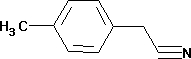
  • 4-Methylphenylacetonitrile, para-Toluacetonitrile
 

P- Toluylacetonitrile Trade Information

  • Minimum Order Quantity
  • 500 Milliliters
  • Supply Ability
  • 50000 Milliliters Per Week
  • Delivery Time
  • 4-5 Days
 

About P- Toluylacetonitrile

LC5544 p-Toluylacetonitrile
for synthesis


Order number Packaging Quantity Price
AC32544 Glass bottle 25 ml 29.93


Product information
Synonyms p-Methylbenzyl cyanide, (p-Methylphenyl)acetonitrile
Hill Formula C9H9N
Chemical formula 4-(CH3)C6H4CH2CN
HS Code 2926 90 95
EC number 220-963-2
Molar mass 131.18 g/mol
CAS number 2947-61-7


Chemical and physical data
Solubility (20 C) insoluble
Melting point 18 C
Molar mass 131.18 g/mol
Density 0.99 g/cm3 (20 C)
Boiling point 242 - 243 C
Flash point 106 C
Refractive index 1.5153 (25 C, 589 nm)


Safety information according to GHS
Hazard Statement(s) H319: Causes serious eye irritation.
Precautionary Statement(s) P260: Do not breathe vapour.
P262: Do not get in eyes, on skin, or on clothing.
P305 + P351 + P338: IF IN EYES: Rinse cautiously with water for several minutes. Remove contact lenses, if present and easy to do. Continue rinsing.
Signal Word Warning
HazardPictogram(s)
Storage class 10 Combustible liquids not in Storage Class 3
WGK WGK 3 highly water endangering
Disposal 3
Relatively unreactive organic reagents should be collected in container A. If halogenated, they should be collected in container B. For solid residues use container C.


Safety information
R Phrase R 36
Irritating to eyes.
S Phrase S 23-24
Do not breathe vapour.Avoid contact with skin.
Categories of danger irritant
Hazard Symbol Irritant


Transport information
Declaration (transport by sea) IMDG-Code UN 3276 NITRILES, TOXIC, LIQUID, N.O.S.(P-TOLYLACETONITRILE), 6.1, II
Declaration (transport by air) IATA-DGR UN 3276 NITRILES, TOXIC, LIQUID, N.O.S.(P-TOLYLACETONITRILE), 6.1, II


Specifications
Assay (GC, area%)  98 %
Density (d 20 C/ 4 C) 0.991 - 0.994
Identity (IR) passes test


Reliable Chemical Intermediate

P-Toluylacetonitrile serves as a vital intermediate in the synthesis of pharmaceuticals and various organic compounds. Its high purity ensures consistent results in research and development, making it a preferred choice for laboratories and manufacturing applications. Versatile and dependable, it streamlines chemical production processes.


Safe Storage and Handling

To maintain stability and ensure safety, P-Toluylacetonitrile should be stored in a tightly sealed container in a cool, dry place. The compound remains stable under standard conditions, but care should be taken to avoid ingestion or inhalation, as it is harmful if not handled properly.


Flexible Packaging Options

Available in bottles or drums, P-Toluylacetonitrile can be supplied in custom packaging sizes to accommodate different research, industrial, and commercial needs. Its practical shelf life of up to 24 months makes it suitable for both bulk storage and regular laboratory usage.

FAQ's of P- Toluylacetonitrile:


Q: How is P-Toluylacetonitrile typically used in organic synthesis?

A: P-Toluylacetonitrile acts as an intermediate in organic synthesis, especially for the creation of pharmaceutical compounds and other advanced chemicals. Its structure supports a variety of reactions, making it valuable in research and production environments.

Q: What precautions should be taken during the storage and handling of P-Toluylacetonitrile?

A: It is essential to store P-Toluylacetonitrile in a cool, dry location with the container tightly closed. Direct inhalation or ingestion should be avoided due to its harmful nature, and standard laboratory safety measures are recommended.

Q: When does P-Toluylacetonitrile expire, and how is its shelf life determined?

A: When stored under recommended conditions-cool and dry with the package tightly sealed-P-Toluylacetonitrile has a shelf life of 24 months. Its stability is maintained if protected from extreme temperatures and moisture.

Q: What are the solubility characteristics of P-Toluylacetonitrile?

A: This compound is slightly soluble in water but readily dissolves in organic solvents. Its solubility profile is particularly useful for applications in chemical synthesis involving non-aqueous environments.

Q: Where can P-Toluylacetonitrile be sourced in India?

A: P-Toluylacetonitrile is available through various dealers, exporters, manufacturers, retailers, suppliers, and traders operating across India. Packaging can be tailored to the buyer's requirements, from small bottles to industrial drums.

Q: What benefits does P-Toluylacetonitrile offer for research and development purposes?

A: Its high purity, reliable stability, and versatile application as an intermediate make P-Toluylacetonitrile advantageous for research professionals and industries seeking consistent results in chemical development projects.

Q: What is the process for handling accidental exposure to P-Toluylacetonitrile?

A: In case of accidental exposure, move the affected individual to fresh air if inhaled, and rinse thoroughly with water if skin or eyes come into contact. Seek medical attention immediately and follow standard laboratory emergency protocols.

Tell us about your requirement
product

Price:

Quantity
Select Unit

  • 50
  • 100
  • 200
  • 250
  • 500
  • 1000+
Additional detail
Mobile number

Email

More Products in Laboratory Chemicals Category

ACETYLENE TETRABROMIDE

ACETYLENE TETRABROMIDE

Price 7215 INR

Minimum Order Quantity : 250 Milliliters

Grade : Laboratory Grade

Purity(%) : 99%

Type : University Lab Chemicals

Appearance : Colorless to pale yellow liquid

BISMUTH SUBNITRATE

BISMUTH SUBNITRATE

Price 5480.00 INR / Kilograms

Minimum Order Quantity : 5 Kilograms, Kilograms

Grade : Laboratory Grade

Purity(%) : 71%

Type : University Lab Chemicals

Appearance : White Powder

Chloro-N, N-dimethylacetamide

Chloro-N, N-dimethylacetamide

Minimum Order Quantity : 500 Millimeters

Grade : Industrial

Purity(%) : 99.99

Type : Industrial Lab Chemicals

BARIUM FLUORIDE AR

BARIUM FLUORIDE AR

Grade : AR

Purity(%) : 99.5%

Type : Other, Inorganic Compound

Appearance : White Powder or Crystalline Solid


We are deals in Lab Chemicals.
"Only deals in retail accepting orders upto 500ml only". 
trade india member
ALPHA CHEMIKA All Rights Reserved.(Terms of Use)
Developed and Managed by Infocom Network Private Limited.