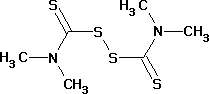
About Tetramethylthiuram Disulfide
LC5771 Tetramethylthiuram disulfide
for synthesis
Order number Packaging Quantity Price
AC32771 Glass bottle
25 g 11.25
AC32771 Glass bottle
100 g 12.06
Product information
Synonyms Bis(dimethylthiocarbamyl) disulphide
Hill Formula C6H12N2S4
HS Code 2930 30 00
EC number 205-286-2
Molar mass 240.44 g/mol
Storage Store below +15C.
EC index number 006-005-00-4
CAS number 137-26-8
Chemical and physical data
Ignition temperature 270 C
Solubility 16.5 mg/l (20 C)
Melting point 148 - 152 C
Molar mass 240.44 g/mol
Density 1.3 g/cm3
Bulk density 480 kg/m3
Boiling point 129 C (26.6 hPa)
Vapor pressure 0.000023 hPa (25 C)
Flash point 89 C
Safety information according to GHS
Hazard Statement(s) H302 + H332: Harmful if swallowed or if inhaled.
H315: Causes skin irritation.
H317: May cause an allergic skin reaction.
H319: Causes serious eye irritation.
H373: May cause damage to organs through prolonged or repeated exposure.
H410: Very toxic to aquatic life with long lasting effects.
Precautionary Statement(s) P273: Avoid release to the environment.
P280: Wear protective gloves.
P302 + P352: IF ON SKIN: Wash with plenty of soap and water.
P305 + P351 + P338: IF IN EYES: Rinse cautiously with water for several minutes. Remove contact lenses, if present and easy to do. Continue rinsing.
P314: Get medical advice/ attention if you feel unwell.
Signal Word Warning
Hazard Pictogram(s)
Storage class 10 - 13 Other liquids and solids
WGK WGK 3 highly water endangering
Disposal 3
Relatively unreactive organic reagents should be collected in container A. If halogenated, they should be collected in container B. For solid residues use container C.
Safety information
R Phrase R 20/22-36/38-43-48/22-50/53
Harmful by inhalation and if swallowed.Irritating to eyes and skin.May cause sensitization by skin contact.Harmful: danger of serious damage to health by prolonged exposure if swallowed.Very toxic to aquatic organisms, may cause long-term adverse effects in the aquatic environment.
S Phrase S 26-36/37-60-61
In case of contact with eyes, rinse immediately with plenty of water and seek medical advice.Wear suitable protective clothing and gloves.This material and its container must be disposed of as hazardous waste.Avoid release to the environment. Refer to special instructions/ Safety data sheets.
Categories of danger harmful, irritant, sensitizing, dangerous for the environment
Hazard Symbol Harmful
Dangerous for the environment
Transport information
Declaration (transport by sea) IMDG-Code UN 2811 TOXIC SOLID, ORGANIC, N.O.S.(TETRAMETHYLTHIURAM DISULFIDE), 6.1, II
Declaration (transport by air) IATA-DGR UN 2811 TOXIC SOLID, ORGANIC, N.O.S.(TETRAMETHYLTHIURAM DISULFIDE), 6.1, II
Toxicological data
LD 50 oral LD50 rat 560 mg/kg
LD 50 dermal LD50 rat > 2000 mg/kg
Specifications
Assay (GC, area%) 97 %
Melting range
- lower value 148 C
- upper value 152 C
Identity (IR) passes test
Key Features of Tetramethylthiuram DisulfideThis compound boasts a high degree of purity and is tailored for laboratory and industrial use, particularly in rubber processing. Its unique chemical properties, including its insolubility in water and reactivity profile, make it valuable for precise scientific and manufacturing applications. The product is offered in customizable packaging options to cater to various customer needs.
Storage and Handling GuidelinesFor optimal longevity, Tetramethylthiuram Disulfide should be stored in a cool, dry place, protected from heat and direct sunlight. It remains stable under recommended conditions but must be isolated from strong oxidizing agents to prevent unwanted reactions. The product's shelf life is 24 months when storage instructions are followed.
FAQ's of Tetramethylthiuram Disulfide:
Q: How should Tetramethylthiuram Disulfide be stored to maintain its stability?
A: Tetramethylthiuram Disulfide should be kept in a cool, dry location, away from direct sunlight and heat sources. Ensure the chemical is stored in its original HDPE bag or drum and avoid exposure to strong oxidizing agents for maximum shelf life and stability.
Q: What is the main application of Tetramethylthiuram Disulfide in industry?
A: Tetramethylthiuram Disulfide is predominantly used as a vulcanization accelerator in the rubber industry, enhancing the cross-linking process during rubber production. It also serves as a reagent in various laboratory experiments and research.
Q: When is Tetramethylthiuram Disulfide typically used in laboratory settings?
A: This compound is utilized in academic and research laboratories as a reagent for chemical synthesis and analytical studies, thanks to its defined reactivity and purity.
Q: Where is Tetramethylthiuram Disulfide manufactured and supplied from?
A: Tetramethylthiuram Disulfide is manufactured, exported, and supplied by qualified dealers, exporters, manufacturers, retailers, suppliers, and traders in India, offering the product for both domestic and international markets.
Q: What benefits does using Tetramethylthiuram Disulfide provide in the rubber industry?
A: In rubber manufacturing, Tetramethylthiuram Disulfide significantly accelerates the vulcanization process, leading to improved product quality and efficiency in production.
Q: Is custom packaging available for Tetramethylthiuram Disulfide?
A: Yes, custom packaging sizes are available upon request, ensuring users receive the amount that best fits their specific industrial or laboratory needs.
Q: What precautions should be taken during the handling process of this compound?
A: Use appropriate personal protective equipment, handle in a well-ventilated area, and never allow the compound to come in contact with strong oxidizing agents to avoid hazardous reactions.


 English
 Spanish
 French
 German
 Italian
 Chinese (Simplified)
 Japanese
 Korean
 Arabic
 Portuguese













 Send Inquiry

 Send Inquiry


