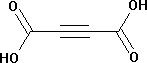
About Acetylenedicarboxylic acid
LC191 Acetylenedicarboxylic acid for synthesis
| Order number | Packaging | Quantity | Price |
| AC27191 | Glass bottle | 10 g | 27.675 |
| Product information |
| Synonyms | Butynedioic acid |
| Hill Formula | C4H2O4 |
| HS Code | 2917 19 90 |
| EC number | 205-536-0 |
| Molar mass | 114.05 g/mol |
| Storage | Store at +2C to +8C. |
| CAS number | 142-45-0 |
| Chemical and physical data |
| Solubility | (20 C) soluble |
| Melting point | 180 - 185 C |
| Molar mass | 114.05 g/mol |
| Bulk density | 550 kg/m3 |
| Flash point | 131 C |
| Safety information |
| Storage class | 10 - 13 Other liquids and solids |
| WGK | WGK 3 highly water endangering |
| Disposal | 4
Liquid organic acids or solutions should be diluted, if necessary, and carefully neutralized with sodium hydrogen carbonate (Cat. No. 106323) or with sodium hydroxide (Cat. No 106462). Before filling into container D, check the pH with pH universal indicator strips (Cat. No. 109535). |
| Transport information |
| Declaration (transport by sea) IMDG-Code | No Dangerous Good |
| Declaration (transport by air) IATA-DGR | No Dangerous Good |
| Specifications |
| Assay (acidimetric) | 97 % |
| Identity (IR) | passes test |
High Purity and Analytical GradeAcetylenedicarboxylic acid is offered at an exceptional 99% purity, making it ideal for sensitive laboratory and research work. Its analytical grade and consistent composition ensure reliability in organic synthesis and laboratory experiments, supporting precise outcomes in university and specialized research facilities.
Optimal Handling and StorageThis chemical should be handled with care, using appropriate protective clothing, gloves, and eye/face protection. To maintain stability and quality, store the container tightly closed in a dry, well-ventilated area. The product remains stable for up to 24 months when stored under recommended conditions, supporting flexible usage in various laboratory settings.
Versatile Laboratory ApplicationsAcetylenedicarboxylic acid finds use in research, laboratory procedures, and as a key intermediate in organic synthesis. Its high solubility in water and characteristic of being odorless add to its suitability for controlled experimental environments in academic and industrial research contexts.
FAQ's of Acetylenedicarboxylic acid:
Q: How should Acetylenedicarboxylic acid be safely handled during laboratory use?
A: Always wear suitable protective clothing, gloves, and eye/face protection when handling Acetylenedicarboxylic acid. Avoid direct contact and inhalation of dust. Handle the compound in a well-ventilated area according to established lab safety guidelines.
Q: What is the recommended storage process for Acetylenedicarboxylic acid?
A: Keep the product tightly sealed in its original bottle, stored in a dry and well-ventilated place, away from moisture and incompatible substances. Proper storage under these conditions ensures a shelf life of up to 24 months.
Q: When is Acetylenedicarboxylic acid typically used in research?
A: This compound is mostly used in university laboratories and research facilities for experiments involving organic synthesis, analytical procedures, and other specialized chemical applications due to its high purity and reliable performance.
Q: Where can Acetylenedicarboxylic acid be applied in scientific work?
A: Its application ranges from fundamental research in organic chemistry to laboratory-scale synthesis and academic experiments, making it valuable in research institutions, universities, and professional laboratory settings.
Q: What are the benefits of using Acetylenedicarboxylic acid with 99% purity for laboratory applications?
A: High purity ensures minimal interference from impurities, which is essential for achieving accurate, consistent, and reproducible results in quantitative research and analytical experiments.
Q: How does the solubility of Acetylenedicarboxylic acid affect its laboratory usage?
A: Being highly soluble in water, it allows for easy preparation of solutions and integration into aqueous chemical reactions, thus broadening its utility in various experimental protocols.
Q: What precautions should be taken given its physical and chemical properties?
A: Although it is not classified as hazardous under GHS and is not flammable, appropriate personal protective equipment should be used to prevent contact, and the product should be handled with standard laboratory precautions due to its decomposing nature at elevated temperatures.


 English
 Spanish
 French
 German
 Italian
 Chinese (Simplified)
 Japanese
 Korean
 Arabic
 Portuguese










 Send Inquiry

 Send Inquiry


