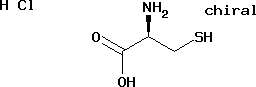
About L-Cysteine hydrochloride monohydrate
LC1777 L-Cysteine hydrochloride monohydrate
suitable for use as excipient exp Ph Eur,USP
Order number Packaging Quantity Price
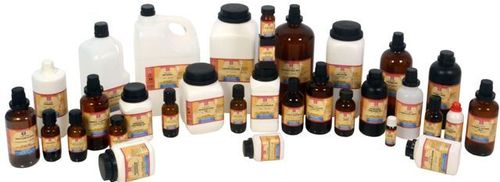
AC28777 Plastic bottle 100 g Inquire
AC28777 Plastic bottle 1 kg Inquire
AC28777 Plastic drum 10 kg Inquire
Product information
Grade Ph Eur,USP
Hill Formula C3H8ClNO2S * H2O
HS Code 2930 90 16
EC number 200-157-7
Molar mass 175.64 g/mol
CAS number 7048-04-6
Chemical and physical data
Solubility 650 g/l (20 C)
Melting point 168 - 170 C
Molar mass 175.64 g/mol
Bulk density 780 kg/m3
pH value 0.8 - 1.2 (100 g/l, H2O, 20 C)
Safety information
RTECS HA2285000
Storage class 10 - 13 Other liquids and solids
WGK WGK 1 slightly water endangering
Disposal 3
Relatively unreactive organic reagents should be collected in container A. If halogenated, they should be collected in container B. For solid residues use container C.
Specifications
Assay (iodometric, calc. on dried substance) 98.5 - 101.0 %
Identity
- IR-spectrum passes test
- chloride passes test
Appearance white to almost white crystalline powder or colorless crystals
Appearance of solution (25 g/l, water) clear and not more intense in color than reference solution BY6
Spec. rotation
- 20/D, 80 g/l, hydrochloric acid 250 g/l, calc. on dried substance +5.5 to +7.0
- 25/D, 80 g/l, hydrochloric acid 6 mol/l, calc. on dried substance +5.7 to +6.8
Sulfate (SO4) 300 ppm
Heavy metals (as Pb) 10 ppm
Fe (Iron) 20 ppm
NH4 (Ammonium) 200 ppm
Ninhydrin - positive substances (total (TLC)) 0.5 %
Residual solvents (Ph. Eur./USP/ICH) excluded by manufacturing proces
Sulfated ash (600 C) 0.1 %
Loss on drying (Vacuum < 0.7 kPa, P2O5, 24 h) 8.0 - 12.0 %
Bacterial endotoxins 6.0 I.U./g
High Purity and Quality ComplianceL-Cysteine hydrochloride monohydrate offers exceptional purity levels greater than 98% and meets strict USP microbial specifications. With a heavy metal limit of less than 10 ppm and a melting point of 240C (decomposition), it ensures dependable performance for research, pharmaceutical, and industrial applications.
Versatile Applications Across IndustriesThis compound plays a crucial role in pharmaceuticals, food processing, and laboratory research. Known for its stability and solubility, it is used for protein synthesis, ingredient formulation, and as a reagent in various biochemical processes. Its utility spans from industrial synthesis to educational laboratories.
Safe Storage and Custom Packaging OptionsL-Cysteine hydrochloride monohydrate should be stored in a cool, dry place, with containers sealed tightly to maintain its integrity. Custom packaging options such as fibre drums, HDPE bags, and glass bottles are available, providing flexibility for different user requirements. It carries a 24-month shelf life when properly stored.
FAQ's of L-Cysteine hydrochloride monohydrate:
Q: How should L-Cysteine hydrochloride monohydrate be stored to maintain its quality?
A: To preserve its stability and purity, store L-Cysteine hydrochloride monohydrate in a cool, dry location with the container tightly closed. Exposure to moisture or heat should be minimized, following standard laboratory practices.
Q: What are the main applications of L-Cysteine hydrochloride monohydrate?
A: This compound is primarily used in pharmaceuticals as a raw material, as a food additive for flavor and preservation, and as a reagent in biochemical research and industrial synthesis.
Q: When is L-Cysteine hydrochloride monohydrate typically used in the laboratory setting?
A: It is commonly used during protein synthesis experiments, enzymatic studies, and chemical reaction protocols where a reliable, high-purity amino acid is required.
Q: Where is L-Cysteine hydrochloride monohydrate supplied and manufactured?
A: It is manufactured, exported, and supplied by various dealers and traders in India, with custom packaging and delivery available for local and international customers.
Q: What benefits does using high-purity L-Cysteine hydrochloride monohydrate offer?
A: High purity ensures reliable and reproducible results in critical applications, minimizes contamination risks, and meets the rigorous standards necessary for pharmaceutical and food industry use.
Q: What process is involved in verifying the quality of L-Cysteine hydrochloride monohydrate?
A: Quality is evaluated by parameters such as assay (over 98%), heavy metal analysis, optical rotation, and USP microbial testing, ensuring suitability for sensitive applications.
Q: How can users select appropriate packaging for their needs?
A: Packaging options include fibre drums, HDPE bags, and glass bottles, allowing selection based on volume, storage conditions, and transport requirements. Custom sizes can be arranged to match specific purposes.


 English
 Spanish
 French
 German
 Italian
 Chinese (Simplified)
 Japanese
 Korean
 Arabic
 Portuguese










 Send Inquiry

 Send Inquiry


