


 English
 Spanish
 French
 German
 Italian
 Chinese (Simplified)
 Japanese
 Korean
 Arabic
 Portuguese



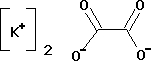
Di-potassium Oxalate Monohydrate
LC5107 di-Potassium oxalate monohydrate
or analysis EMSURE
Order number Packaging Quantity Price
AC32107 Plastic bottle 250 g 18.225
AC32107 Plastic bottle 1 kg
54.00
Product information
Synonyms Oxalic acid dipotassium salt monohydrateC2K2O4 * H2O
Hill Formula K2C2O4 * H2O
Chemical formula K2C2O4 * H2O
HS Code 2917 11 00
EC number 209-506-8
Molar mass 184.24 g/mol
EC index number 184.24 g/mol
CAS number 6487-48-5
Chemical and physical data
Solubility 360 g/l (20 C) (anhydrous substance)
Molar mass 184.24 g/mol
Density 2.13 g/cm3 (20 C)
Bulk density 700 - 1100 kg/m3
pH value 7.0 - 8.5 (50 g/l, H2O, 20 C)
Vapor pressure (20 C)
Safety information according to GHS
Hazard Statement(s) H312: Harmful in contact with skin.
H302: Harmful if swallowed.
Precautionary Statement(s) P302 + P352: IF ON SKIN: Wash with plenty of soap and water.
Signal Word Warning
Hazard Pictogram(s)
Storage class 10 - 13 Other liquids and solids
WGK WGK 1 slightly water endangering
Disposal 3
Relatively unreactive organic reagents should be collected in container A. If halogenated, they should be collected in container B. For solid residues use container C.
Safety information
R Phrase R 21/22
Harmful in contact with skin and if swallowed.
S Phrase S 24/25
Avoid contact with skin and eyes.
Categories of danger harmful
Hazard Symbol Harmful
Toxicological data
LD 50 oral LD50 rat 660 mg/kg
Specifications
Assay (oxidimetric) 99.5 - 101.0 %
Insoluble matter 0.01 %
Neutrality passes test
Chloride (Cl) 0.001 %
Sulphate (SO4) 0.01 %
Heavy metals (as Pb) 0.001 %
NH4 (Ammonium) 0.002 %
Fe (Iron) 0.0005 %
Na (Sodium) 0.02 %
Substances darkened by hot sulfric acid passes test

Price:
Minimum Order Quantity : 5 Grams
Grade : Laboratory Grade
Type : University Lab Chemicals
Purity(%) : 99
Application : Industrial, Laboratory
Storage Instructions : Store in a cool and dry place, Keep away from moisture
Minimum Order Quantity : 500 Milliliters
Grade : Industrial
Type : Industrial Lab Chemicals
Purity(%) : 99.99
Application : Lab Chemicals
Storage Instructions : Dry Place
Grade : Industrial
Type : Industrial Lab Chemicals
Purity(%) : 99.99
Application : Lab Chemicals
Storage Instructions : Dry Place
Grade : Industrial
Type : Industrial Lab Chemicals
Purity(%) : 99.99
Application : Lab Chemicals
Storage Instructions : Dry Place




|
 |
ALPHA CHEMIKA
All Rights Reserved.(Terms of Use) Developed and Managed by Infocom Network Private Limited. |

 Send Inquiry

 Send Inquiry


