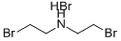
About 2-Bromoethylammonium Bromide
LC1520 2-Bromoethylammonium bromide
for synthesis
Order number Packaging Quantity Price
AC28520 Glass bottle 100 g
23.40
AC28520 Glass bottle 500 g 81.90
Product information
Synonyms 2-Bromoethylamine hydrobromide
Hill Formula C2H7Br2N
Chemical formula BrCH2CH2NH3Br
HS Code 2921 19 99
EC number 219-924-2
Molar mass 204.89 g/mol
CAS number 2576-47-8
Chemical and physical data
Solubility >500 g/l (20 C)
Melting point 167 - 172 C
Molar mass 204.89 g/mol
pH value 4.7 (25 g/l, H2O, 20 C)
Safety information according to GHS
Hazard Statement(s) H302: Harmful if swallowed.
H317: May cause an allergic skin reaction.
H412: Harmful to aquatic life with long lasting effects.
Precautionary Statement(s) P273: Avoid release to the environment.
P280: Wear protective gloves/protective clothing/eye protection/face protection.
P302 + P352: IF ON SKIN: Wash with plenty of soap and water.
Signal Word Warning
Hazard Pictogram(s)
Storage class 10 - 13 Other liquids and solids
WGK WGK 2 water endangering
Disposal 3
Relatively unreactive organic reagents should be collected in container A. If halogenated, they should be collected in container B. For solid residues use container C.
Safety information
R Phrase R 22-43-52/53
Harmful if swallowed.May cause sensitization by skin contact.Harmful to aquatic organisms, may cause long-term adverse effects in the aquatic environment.
S Phrase S 36/37-61
Wear suitable protective clothing and gloves.Avoid release to the environment. Refer to special instructions/ Safety data sheets.
Categories of danger harmful, sensitizing, dangerous for the environment
Hazard Symbol
Harmful
Transport information
Declaration (transport by sea) IMDG-Code UN 2811 TOXIC SOLID, ORGANIC, N.O.S.(2-BROMOETHYLAMMONIUM BROMIDE), 6.1, III
Declaration (transport by air) IATA-DGR UN 2811 TOXIC SOLID, ORGANIC, N.O.S.(2-BROMOETHYLAMMONIUM BROMIDE), 6.1, III
Toxicological data
LD 50 oral LD50 rat > 200 - 2000 mg/kg
Specifications
Assay (argentometric) 99 %
Melting range
- lower value 171 C
- upper value 175 C
Identity (IR) passes test
Versatile Applications in Chemical Synthesis2-Bromoethylammonium Bromide is highly valued for its role as an intermediate in the pharmaceutical industry and in a wide range of organic synthesis processes. Researchers and manufacturers utilize it due to its consistent purity and stability, which are crucial for successful experimental results.
Storage and Shelf Life Best PracticesTo ensure the longevity and safety of 2-Bromoethylammonium Bromide, store the compound in a tightly sealed glass or HDPE bottle, away from moisture and direct sunlight. Its shelf life of up to two years makes it a reliable choice for extended laboratory or industrial projects.
FAQ's of 2-Bromoethylammonium Bromide:
Q: How should 2-Bromoethylammonium Bromide be stored for maximum stability?
A: Store the compound in a cool, dry place in a tightly sealed container, such as a glass or HDPE bottle, to maintain its stability and shelf life of up to two years.
Q: What are the recommended safety precautions when handling this compound?
A: Wear gloves and use suitable protective equipment since 2-Bromoethylammonium Bromide is classified as an irritant. Avoid contact with skin, eyes, and avoid inhalation of dust.
Q: Where can 2-Bromoethylammonium Bromide be used?
A: This compound is mainly utilized in research laboratories and as an intermediate in the synthesis of pharmaceuticals and other organic compounds.
Q: When is it appropriate to use 2-Bromoethylammonium Bromide in chemical synthesis?
A: It is suitable for use when high purity and stable intermediates are required for the synthesis of pharmaceuticals, and other organic compounds in controlled laboratory settings.
Q: What are the benefits of using this organic bromide salt in research?
A: Its high purity (99%), stable solid form, and water solubility make it reliable and efficient for precise experimental outcomes, especially in pharmaceutical and synthetic chemistry projects.
Q: How is 2-Bromoethylammonium Bromide supplied and transported?
A: The compound is packaged in glass or HDPE bottles and is not regulated as a dangerous good, simplifying shipping and handling for research suppliers and laboratories.
Q: What is the process for using 2-Bromoethylammonium Bromide in laboratory applications?
A: Dissolve the required amount in water or a compatible solvent as per experimental protocol, ensuring the use of appropriate safety gear due to its irritant nature.


 English
 Spanish
 French
 German
 Italian
 Chinese (Simplified)
 Japanese
 Korean
 Arabic
 Portuguese



 Send Inquiry





 Send Inquiry

 Send Inquiry


