About Crystal Violet
Crystal Violet is also called as gentian violet and methyl violet 10B, which is known tobe a historical stain for classifying bacteria. The chemical formula, molecular weight and melting point of the mentioned organic compound is C25N3H30Cl, 407.979 g/mol and 205 degree Celsius, respectively. Offered compound appears to be blue-violet in color, when it is dissolved in water. It is highly demanded in the chemical industry and pharmaceuticals because of its anti-bacterial, anthelmintic and anti-fungal properties.
Certificate of Analysis :-
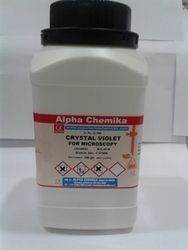
- Name : CRYSTAL VIOLET FOR MICROSCOPY CRYSTAL
- Methyl Violet : 1OB C I Basic Violet 3
- Synonym : Basic Violet 3, Methyl Violet 10B, Gentian Violet, Hexamathylpararosaniline
- IUPAC Name : Tris(4-(dimethylamino)phenyl)methylium
- Molar Mass : 407.979 g/mol
- Formula : C25N3H30Cl
- Density : 1.19 g/cm cube
- EC Number : 208-953-6
- MDL Numbar : MFCD00011750
- PubChem Substance ID : 57654029
- C.I. No. : 42555
- MP : 401 Fdeg
- Product Description : Cation based violet dye
- Assay : 96.0 100.5%
- Identification test To pass A, B & C tests
- Water NMT : 7.5%
- Residue on ignition NMT : 1.5%
- Alcohol-insoluble substances NMT : 1.0%
- Arsenic NMT : 0.001%
- Lead NMT : 0.003%
- Zinc Passes test
- Chromatographic purity : Passes test
- Un No : 9/3077
- TARIFF : 3204 13 49
Applications :-
- Its components are used for inking ball point pens, ink jet printers, etc.
- Fertilizers, detergents, leathers, anti-freezers can be easily colored
- Marking is made on skin during the preparation of surgery
- In paper and print industry, it helps in dying paper
Crystal Violet stands as a preferred choice for microbiologists and lab technicians due to its high purity and effectiveness in biological staining and pH indication. Its unique coloration and reliable results make it essential for diagnostic laboratories, educational purposes, and research centers.
Safety and Storage GuidelinesAs a Class 9 hazardous substance, Crystal Violet should be handled with caution. Store the powder in a cool, dry area away from direct sunlight, using HDPE or glass bottles to maintain its stability and shelf life. Proper storage ensures product integrity and safety in the laboratory environment.
Applications and UsageCrystal Violet is widely used in Gram staining for microbiology, histology, and as a chemical indicator in laboratories. Its reliable staining properties enhance cell visualization and support accurate laboratory results, benefiting both research and diagnostic applications.
FAQ's of Crystal Violet:
Q: How should Crystal Violet be stored to maintain its stability and effectiveness?
A: Crystal Violet should be kept in a cool, dry place away from light, preferably in HDPE or glass bottles. This ensures stability and preserves its 5-year shelf life when unopened and stored under proper conditions.
Q: What are the common applications of Crystal Violet in laboratories?
A: Crystal Violet is primarily used as a biological stain in microbiology and histology, and also serves as a pH indicator. It facilitates cell visualization, microbial identification, and assists in various research protocols.
Q: When is it appropriate to use Crystal Violet as a pH indicator?
A: Crystal Violet is suitable as a pH indicator in solutions with a pH near 3.0, where it displays reliable color changes and sensitivity that assist with accurate pH measurements in experimental and analytical procedures.
Q: Where can Crystal Violet be used in the scientific process?
A: Crystal Violet is used in staining bacterial cells during the Gram staining process, and in histological studies for visualizing cellular components. It can also be applied in research and educational labs across India.
Q: What safety precautions should be observed when handling Crystal Violet?
A: Due to its toxic and possibly carcinogenic nature, users should avoid inhalation, ingestion, and direct skin contact. Personal protective equipment like gloves, masks, and eye protection are recommended during handling.
Q: How is Crystal Violet beneficial for scientific analysis?
A: Crystal Violet offers precise and vibrant staining of biological samples, improving visibility under a microscope. Its reliable performance supports high-quality, reproducible results in clinical, educational, and research settings.
Q: What is the process of dissolving Crystal Violet for laboratory use?
A: Crystal Violet is freely soluble in water and ethanol. Simply add the required amount of powder to the solvent and mix until fully dissolved, creating a ready-to-use staining or indicator solution for laboratory tests.


 English
 Spanish
 French
 German
 Italian
 Chinese (Simplified)
 Japanese
 Korean
 Arabic
 Portuguese










 Send Inquiry

 Send Inquiry


