About Basic Fuchsin
Technical Specifications :-
Chemical Name : Basic Fuchsin
Synonym : Basic Parafuchsin, Parafuchsin Hydrochloride, Basic Red 9, Paramagenta Hydrochloride
CAS No. : 632-99-5
EC NO. : 209-321-2
PubChem Substance ID : 24852906
C.I. No. : 42510
HSN Code : 32049000
Empirical Formula : C20H20ClN3
M.W. : 337.85 g/mol
M.P. : 268-270 degC
Density : 1.22
Color : Green
Odour : Odourless
Solubility : Soluble in water
Absorption : 545 nm
Dye Content : Min. 88%
Loss on drying : Max. 15%
Application :-
A flourescent dye used for stainning and for the Ziel-Neelson method.High-Performance Biological StainTailored for laboratory and industrial needs, Basic Fuchsin delivers vibrant, reliable staining. It serves researchers, educators, and professionals across histology, textile dyeing, and microscopy. The compound's high solubility in water and alcohol guarantees straightforward preparation and consistent staining results.
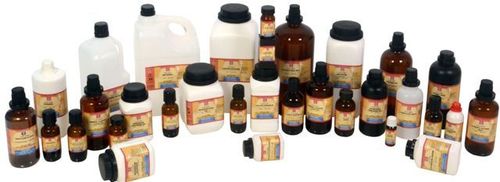
Safe Handling and StorageGiven its classification as a toxic (Hazard Class 6.1) and light-sensitive substance, Basic Fuchsin must be handled with care. Store it in cool, dry conditions in tightly sealed HDPE or glass bottles to uphold safety and preserve product integrity.
Versatile Applications Across IndustriesWhether you are in academia, textile manufacturing, or a research setting, Basic Fuchsin's purity and efficacy make it a staple chemical. Its reliable staining capability enhances molecular visibility in microscopy and histology, while also imparting strong coloration in textiles.
FAQ's of Basic Fuchsin:
Q: How should Basic Fuchsin be stored to maintain its stability and effectiveness?
A: To ensure Basic Fuchsin retains its quality, keep it tightly sealed in HDPE or glass bottles, stored in a cool, dry location. Since it is light-sensitive, avoid exposure to direct sunlight during use and storage.
Q: What are the primary applications of Basic Fuchsin in laboratory and industrial settings?
A: Basic Fuchsin is commonly used as a biological stain in microscopy and histology, as well as a dye in textile industries. Its strong staining potency makes it valuable for visualizing cellular components and molecular structures.
Q: When should Basic Fuchsin be utilized in microscopy or histology procedures?
A: Researchers and technicians use Basic Fuchsin during staining protocols where enhanced contrast and visibility of biological specimens or tissue sections are required. Its effectiveness depends on proper dilution and application under controlled conditions.
Q: Where is Basic Fuchsin commonly employed in research and industry?
A: This chemical finds use in university laboratories, textile manufacturing plants, research institutions, and clinical histology laboratories, across India and internationally, owing to its versatile staining properties and high purity.
Q: What is the recommended process for dissolving Basic Fuchsin for laboratory use?
A: Basic Fuchsin easily dissolves in water or alcohol. Prepare a 1% solution by weighing the appropriate amount and mixing it with your chosen solvent, ensuring complete dissolution before use in staining procedures.
Q: Are there significant benefits to using Basic Fuchsin of laboratory grade and high purity?
A: Absolutely. Laboratory-grade Basic Fuchsin with over 99% purity ensures dependable, reproducible results in analytical and staining applications, reducing the risk of contamination and inconsistent staining outcomes.
Q: What safety measures should be followed during the handling and use of Basic Fuchsin?
A: As a toxic and light-sensitive substance, always wear suitable protective equipment, such as gloves and goggles, and work in a well-ventilated area. Store and dispose of the material according to local safety regulations.


 English
 Spanish
 French
 German
 Italian
 Chinese (Simplified)
 Japanese
 Korean
 Arabic
 Portuguese










 Send Inquiry

 Send Inquiry


