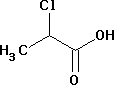
LC1312 2-Chloropropionic acid
for synthesis
Order number Packaging Quantity Price
AC28312
Glass bottle 100 ml
11.88
AC28312
Glass bottle 500 ml 14.22
Product information
Synonyms a-Chloropropionic Acid
Hill Formula C3H5ClO2
Chemical formula CH3CHClCOOH
HS Code 2915 90 00
EC number 209-952-3
Molar mass 108.52 g/mol
EC index number 607-139-00-1
CAS number 598-78-7
Chemical and physical data
Ignition temperature 550 C
Solubility (20 C) soluble
Melting point -12 C
Molar mass 108.52 g/mol
Density 1.27 g/cm3 (20 C)
pH value < - 1 (200 g/l, H2O, 20 C)
Boiling point 185 - 186 C
Vapor pressure 4 hPa (60 C)
Explosion limit 107 C
Flash point 1.4345 (20 C, 589 nm)
Safety information
R Phrase R 22-35
Harmful if swallowed.Causes severe burns.
S Phrase S 23-26-28-36-45
Do not breathe vapour.In case of contact with eyes, rinse immediately with plenty of water and seek medical advice.After contact with skin, wash immediately with plenty of water.Wear suitable protective clothing.In case of accident or if you feel unwell, seek medical advice immediately (show the label where possible).
Categories of danger harmful, corrosive
Hazard Symbol Corrosive
Storage class 8 A Combustible substances, corrosive
WGK WGK 1 slightly water endangering
Disposal 4
Liquid organic acids or solutions should be diluted, if necessary, and carefully neutralized with sodium hydrogen carbonate (Cat. No. 106323) or with sodium hydroxide (Cat. No 106462). Before filling into container D, check the pH with pH universal indicator strips (Cat. No. 109535).
Transport information
Declaration (transport by sea) IMDG-Code UN 2511 2-CHLOROPROPIONIC ACID, 8, III, Segregation Group: 1 (Acids)
Declaration (transport by air) IATA-DGR UN 2511 2-CHLOROPROPIONIC ACID, 8, III
Toxicological data
LD 50 oral LD50 rat 500 mg/kg
Specifications
Assay (GC, area%) 95 %
Density (d 20 C/ 4 C) 1.260 - 1.270
2,2-Dichloropropionic acid (GC, area%) 4%
Identity (IR) passes test
2-Chloropropionic Acid is characterized by its high purity, solubility in various solvents, and stable liquid form. With a melting point at -12C and boiling at 195C, it is commonly used as an intermediate in pharmaceutical and agrochemical syntheses. Its customizable packaging and long shelf life (2 years) make it suitable for varied industrial, laboratory, and research uses.
Due to its corrosive nature and ability to cause burns, it is crucial to handle 2-Chloropropionic Acid with proper safety precautions. Store the acid in air-tight bottles or drums, away from strong bases and oxidizing agents, in a cool, dry, and well-ventilated place. Usage in controlled environments ensures its stability and maximizes shelf life.
FAQ's of 2-Chloropropionic Acid:
Q: How should 2-Chloropropionic Acid be stored to maintain its stability?
A: 2-Chloropropionic Acid should be stored tightly closed in a cool, dry, and well-ventilated area, away from strong bases and oxidizing agents, to ensure stability and preserve its two-year shelf life.
Q: What are the typical applications of 2-Chloropropionic Acid?
A: This compound is widely used as an intermediate in the synthesis of pharmaceutical and agrochemical products due to its high purity and chemical reactivity.
Q: When is it beneficial to use 2-Chloropropionic Acid as an intermediate?
A: It is beneficial to use this acid when a reliable, high-purity source of a reactive organic intermediate is needed for the formulation of pharmaceutical compounds or agricultural chemicals.
Q: Where can 2-Chloropropionic Acid be sourced in India?
A: 2-Chloropropionic Acid is available from various dealers, exporters, manufacturers, retailers, suppliers, and traders across India. Packaging can be customized as per the buyer's requirements.
Q: What precautions should be taken during the handling process?
A: Due to its corrosive and burn-causing nature, appropriate personal protective equipment such as gloves, goggles, and lab coats should be worn. Work should be conducted in a well-ventilated area or fume hood.
Q: How is 2-Chloropropionic Acid transported safely?
A: The product is classified under UN 3265, Class 8 (corrosive substances), and should be packed securely in bottles or drums as per legal transport regulations to mitigate risk during transit.
Q: What are the compatibility concerns for 2-Chloropropionic Acid in storage and usage?
A: You should avoid contact with strong bases and oxidizing agents, as these may cause hazardous reactions with 2-Chloropropionic Acid.


 English
 Spanish
 French
 German
 Italian
 Chinese (Simplified)
 Japanese
 Korean
 Arabic
 Portuguese











 Send Inquiry

 Send Inquiry


