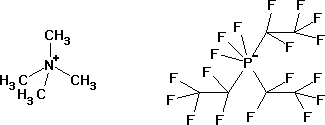
Tetramethylammonium tris (pentafluoroethyl) trifluorophosphate About
LC5748 Tetramethylammonium tris(pentafluoroethyl)trifluorophosphate
for synthesis
Order number Packaging Quantity Price
AC32748 Glass bottle 25 g inquire
AC32748 Glass bottle 100 g inquire
AC32748 Glass bottle 500 g
inquire
Product information
Hill Formula C10H12F18NP
Chemical formula (CH3)4N((C2F5)3PF3)
HS Code 2931 00 99
Molar mass 519.15 g/mol
CAS number 394692-83-2
Chemical and physical data
Melting point 115 C
Molar mass 519.15 g/mol
pH value 6 (0.01 g/ml, H2O, 25 C)
Safety information
Storage class 10 - 13 Other liquids and solids
WGK WGK 3 highly water endangering
Specifications
Assay (electrophoresis) 98.0 %
Water (K. F.) 1.0 %
Halides 0.1 %
Identity (IR) passes test
Versatile Applications in Modern ChemistryTetramethylammonium tris(pentafluoroethyl) trifluorophosphate serves as a valuable phase-transfer catalyst and synthetic intermediate in various laboratory and industrial processes. Its exceptional purity and solubility make it suitable for complex reactions and advanced chemical syntheses. Researchers and manufacturers benefit from its consistent performance and compatibility with inert materials.
Storage and Handling RecommendationsTo maintain stability, store TMA PETPP in a cool, dry place within a tightly closed container. Direct skin contact should be avoided; always use gloves and protective equipment when handling. The compound is stable under recommended storage conditions and has a shelf life of up to 24 months, ensuring reliability for extended laboratory or manufacturing use.
FAQ's of Tetramethylammonium tris (pentafluoroethyl) trifluorophosphate:
Q: How should Tetramethylammonium tris(pentafluoroethyl) trifluorophosphate be safely handled during laboratory use?
A: Always handle this chemical with protective gloves and appropriate safety equipment, as it is classified as an irritant. Use inert and non-reactive materials and avoid skin or eye contact.
Q: What are the primary applications for TMA PETPP in research and industry?
A: TMA PETPP is widely used as a synthetic intermediate and as a phase-transfer catalyst in chemical synthesis, supporting advanced research and various industrial processes.
Q: When is it necessary to use custom packaging for Tetramethylammonium tris(pentafluoroethyl) trifluorophosphate?
A: Custom packaging is recommended when specific quantities or storage requirements are needed for research or manufacturing purposes, ensuring both convenience and safety during handling and storage.
Q: Where should TMA PETPP be stored to maintain its quality?
A: Store the product in a cool, dry location, tightly sealed in its container, away from sources of moisture and heat to ensure stability throughout its 24-month shelf life.
Q: What benefits does using TMA PETPP provide in chemical synthesis?
A: Its high purity, excellent solubility in polar organic solvents, and reliable phase-transfer capability enhance reaction efficiency and yield in laboratory and industrial syntheses.
Q: Is Tetramethylammonium tris(pentafluoroethyl) trifluorophosphate regulated for transport or classified under any hazardous shipping codes?
A: No, this compound is not regulated for transport; it carries no assigned EC Number or UN Number, and shipping is straightforward using HS Code 29349900.


 English
 Spanish
 French
 German
 Italian
 Chinese (Simplified)
 Japanese
 Korean
 Arabic
 Portuguese










 Send Inquiry

 Send Inquiry


